This post contains affiliate links. If you buy through them, Securely Sorted may earn a commission at no extra cost to you. As an Amazon Associate, we earn from qualifying purchases. Learn more.
No, TP-Link routers are not banned for people who already own them, and models that were approved before March 2026 can still be sold. What changed is that the US stopped approving new foreign-made router models from almost every brand, and TP-Link hasn’t yet received the exemption that Netgear, eero and Asus have. If you have a TP-Link router, the most important thing is the same as for any brand: make sure it still gets security updates.
Few tech stories in the last two years have caused as much confusion as this one. Headlines have mentioned bans, lawsuits and national security, and a lot of people are asking whether the router in their living room is suddenly illegal or unsafe. Here’s what actually happened, as of October 2026, and what it means for you.
What happened
There are two separate stories here, and they often get mixed together.
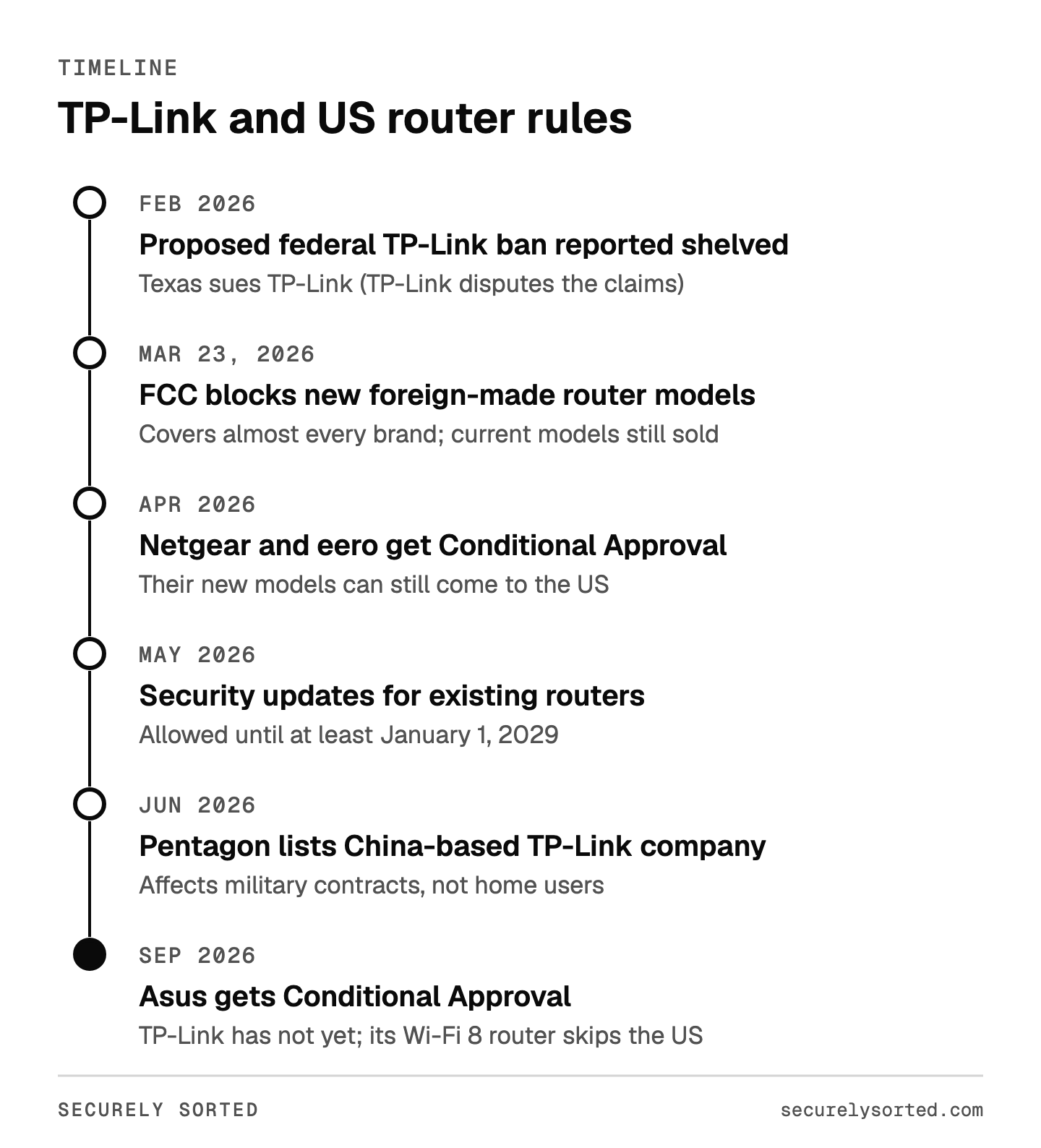
1. Concerns about TP-Link specifically. TP-Link is the biggest home router brand in the US. In late 2024, reports emerged that federal agencies were investigating the company over its ties to China, and Microsoft researchers reported that a hacking group was using a large network of hijacked home routers, mostly TP-Link models, in attacks. A proposed federal ban on TP-Link routers followed, but it was reported shelved in early 2026. Separately:
- Texas sued TP-Link in February 2026, accusing it of misleading customers about where its products come from and how secure they are. TP-Link says the claims are “without merit” and that the Chinese government has no ownership or control over the company.
- In June 2026, the Pentagon added TP-Link Technologies Co., Ltd., the China-based company, to its list of Chinese military companies. That list limits what the Defense Department can buy and who it can contract with. It does not stop people from buying or using products at home.
2. A new rule for almost all routers. On March 23, 2026, the FCC added consumer routers made outside the United States to its “Covered List.” That blocks new router models from being approved for sale unless the company gets a special exemption called Conditional Approval. Because nearly every home router is made at least partly overseas, this affects almost every brand, not just TP-Link.
What TP-Link says
TP-Link’s US business, TP-Link Systems Inc., is headquartered in Irvine, California. The company says it split from the China-based TP-Link Technologies in 2024 and that the two now have entirely separate ownership, management and operations. It has said it is seeking Conditional Approval from the FCC. As of early October 2026, it hasn’t received it, and it opened preorders for its first Wi-Fi 8 router in places like the UK, Germany, Canada and Australia, but not the US.
What it means if you already own a TP-Link router
- It’s legal to keep using it. Nothing in the FCC rule or the Pentagon list requires you to stop using or replace a router you already own.
- It can still get security updates. The FCC allows makers to keep sending software and security updates to routers that were already approved. That permission now runs until at least January 1, 2029.
- Stores can still sell models approved before the rule. You may still see TP-Link routers on store shelves. What’s blocked is brand-new models.
The bigger risk for most people isn’t the brand. It’s an old router that no longer gets updates, from any company. The FBI’s recent warnings about hijacked routers focus on devices that are out of date or past their support life.
What to do now
- Check that your router still gets updates. Look up your model on the maker’s support site. If it’s listed as end of life, or hasn’t had a firmware update in a long time, plan to replace it.
- Update it and lock it down. Follow our 20-minute guide: How to Secure Your Home Wi-Fi Router. Change the admin password, turn on automatic updates, and turn off remote management, WPS and UPnP.
- Decide whether you want to switch. If your TP-Link router is supported and updated, you don’t have to replace it today. Some people will still choose to, especially small businesses, government contractors, or anyone who’d rather avoid the uncertainty while the rules settle.
Brands that already have Conditional Approval, such as Netgear, eero and Asus, can keep bringing new models to the US, which makes future updates and replacements more predictable. Whatever you buy, check how long the maker promises security updates.
Options to compare: Netgear on Amazon, eero on Amazon, Asus on Amazon.
A lot of the coverage of this story is louder than it needs to be. If you own a TP-Link router, you haven’t done anything wrong, and you don’t need to rip it out tonight. Spend ten minutes checking for updates and securing the settings. That does more for your safety than switching brands without doing either.
TP-Link routers aren’t banned for home users. The 2026 FCC rule blocks new foreign-made router models from almost every brand unless they get an exemption, and TP-Link hasn’t received one yet. Keep any router you own updated, replace it if it’s past its support life, and if you’re buying new, favor a brand with a clear path to future updates.
This story is still moving. We’ll update this guide when the rules or TP-Link’s status change.
Sources: FCC: Fact sheet on foreign-made routers and the Covered List, Cooley: FCC moves to prevent new foreign routers, DLA Piper: FCC announces Covered List exemptions, ClearanceJobs: FCC extends update waiver to 2029, WilmerHale: Pentagon 1260H list update, The Register: Texas sues TP-Link, The Record: TP-Link responds to Texas, BleepingComputer: FBI warning on end-of-life routers, 9to5Mac: Federal TP-Link ban shelved, Tom’s Hardware: Asus gains Conditional Approval, TP-Link Systems statement.

Mcarthur, Founder of Securely SortedI’ve spent 5+ years in hands-on technical support, and now I’m writing the guides I wished existed.